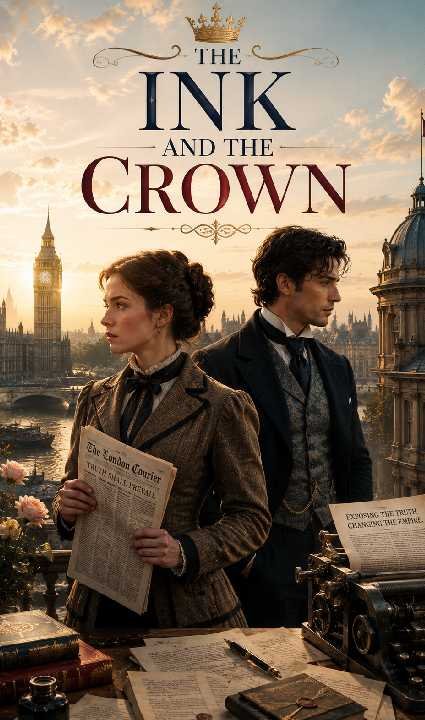
The Ink and the Crown
Read The Ink and the Crown, a historical romance where a fearless journalist and a disgraced lord uncover a dangerous conspiracy that could change Victorian England forever.
Chapter 3: What history remembers
The Mote reception was everything Eliza had expected of a Mayfair house in November: too warm, too loud, and populated entirely by people performing versions of themselves for each other’s benefit. She wore a borrowed gown of deep green that her landlady had pressed without asking questions, and Edmund arrived at her door in evening clothes that fit him with the ease of a man who had worn them all his life which he had, she reminded herself, until three years ago, when a file of accounts had taken everything except the clothes.
They moved through the reception as though they had done it together before. His hand at the small of her back was a navigational gesture, nothing more, and she noted with some irritation that it was also the steadiest she had felt all evening. She worked the room with the practiced ease of a woman who had interviewed prime ministers and dock workers with equal facility, drawing Sir Harlan Mote into a conversation about Colonial trade policy that was precisely interesting enough to hold his attention for twelve minutes.
Twelve minutes was what Edmund needed. She knew because they had agreed on it, standing in his Holborn rooms over a hand-drawn map of the house, speaking in the low focused tones of two people who had stopped pretending the work was the only thing keeping them in the same room.
He was back in eleven.
The document was everything the letter had promised a signed authorization connecting the Board of Trade official directly to the fraudulent accounts, in a hand that could not be disputed and a format that could not be recontextualized. Eliza read it once in the carriage on the way back to Bloomsbury and understood immediately that it was enough. It was more than enough. It was the kind of evidence that did not merely end careers but reshaped the public record.
“I can have it set by tomorrow morning,” she said. “Printed by noon. On every news stand in the city before anyone can apply for an injunction.”
“Then do it,” Edmund said. He was looking out the carriage window at the wet November streets, and his voice had the quality of a man setting something down that he had carried a very long way. “Do it exactly as you see fit. You know how to make it land. I never did.”
Eliza looked at him at the precise angle of his profile in the passing lamplight, at the three years of careful, solitary effort that had cost him everything and produced, alone, nothing, because the truth without a voice to carry it was only a document in a locked room.
“Edmund,” she said. He turned. “When this is printed when it is done I would like to write the full account. Not just the exposure. The story of how it was found.” She held his gaze across the narrow carriage. “With your name on it. Beside mine.”
Something crossed his face that she had not seen there before not the careful blankness of a man protecting himself, but the open, unguarded expression of one who has just been offered something he had stopped believing was available to him.
“That would require,” he said slowly, “a considerable number of additional conversations.”
“Yes,” Eliza said. “It would.”
“Then I accept,” said Edmund Ashby, and for the first time in three years, he smiled without reservation, in a hired carriage on a rainy London street, next to a woman who had walked into his grief with a letter and no apology and rewritten the ending entirely.
The story ran the next morning. By afternoon, it had changed everything. By evening, neither of them was reading the papers.
💬 Reviews
✨ Trending Stories
 The Cartographer of Small Things
 is a touching story about grief, memory, and finding meaning in life's quiet, overlooked moments.
The Cartographer of Small Things
The Cartographer of Small Things is a touching story about grief, memory, and finding meaning in life's quiet, overlooked moments.
 The Silence at No. 9
In The Silence at No. 9, a detective must uncover the truth behind a missing man before powerful enemies erase every clue.
The Silence at No. 9
In The Silence at No. 9, a detective must uncover the truth behind a missing man before powerful enemies erase every clue.
 The Wrong Door
When Nora finds her neighbour unconscious, The Wrong Door becomes a fast-paced thriller filled with secrets, danger, and betrayal.
The Wrong Door
When Nora finds her neighbour unconscious, The Wrong Door becomes a fast-paced thriller filled with secrets, danger, and betrayal.
 The Map of No Return
 follows a brilliant cartographer and a fearless jungle guide as they uncover a lost city and ancient secrets.
The Map of No Return
The Map of No Return follows a brilliant cartographer and a fearless jungle guide as they uncover a lost city and ancient secrets.
 The Last Exhibit
Read The Last Exhibit, a gripping mystery where a detective and a master art forger uncover stolen masterpieces, hidden secrets, and a decades-old conspiracy.
The Last Exhibit
Read The Last Exhibit, a gripping mystery where a detective and a master art forger uncover stolen masterpieces, hidden secrets, and a decades-old conspiracy.
 The Space Between Songs
Read The Space Between Songs, a heartfelt romance about a music publicist and a celebrated songwriter who discover love, healing, and second chances through music.
The Space Between Songs
Read The Space Between Songs, a heartfelt romance about a music publicist and a celebrated songwriter who discover love, healing, and second chances through music.