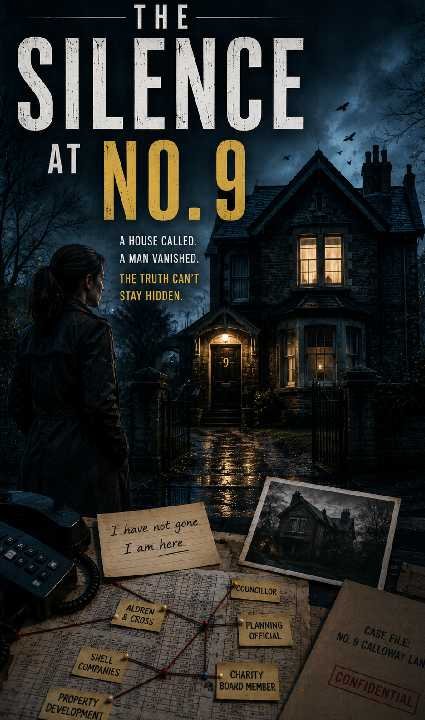
The Silence at No. 9
In The Silence at No. 9, a detective must uncover the truth behind a missing man before powerful enemies erase every clue.
Chapter 1: The House That Reported Itself
The call came in at 6:03 a.m. on a Friday, which was the kind of hour that made Detective Iris Vane suspect the day had already decided what it was going to be.
The strange part stranger than the hour, stranger even than the address was who had made the call. Not a neighbour. Not a passerby. The call had come from inside the house itself. From the landline at No. 9 Calloway Lane, a detached Victorian on the quiet end of a quiet street, where a man named Edmund Grath had lived alone for eleven years. The call had lasted four seconds. No voice. Just the sound of a room the particular acoustic of a space with high ceilings and no soft furnishings and then silence, and then the line going dead.
Edmund Grath was not in the house when Iris arrived.
Nobody was.
The front door was locked. The windows were latched from the inside. The back door, accessible through a side gate that required a key she found hanging neatly on a hook inside the kitchen which she reached by breaking the smallest window in the utility room, a fact she would explain in her report in the most reasonable terms she could construct was also locked, also from the inside.
A locked house that had called the police from its own telephone at 6 a.m. and contained no person.
Iris stood in the kitchen and looked at it the way she looked at all things that didn’t make sense steadily, without rushing to fill the gap with an explanation, because explanations reached for too quickly were just guesses wearing suits.
The kitchen was clean. Not recently cleaned the kind of deeply embedded clean that came from years of habitual order. One mug on the drying rack. One plate. The bin empty and re-lined. On the table, a single envelope, unsealed, addressed in handwriting so precise it looked typeset: For whoever finds this first.
She did not touch it yet. She photographed it. She photographed the room, the table, the mug on the rack, the hook where the back door key had been hanging hanging, she noted, on the inside, which raised its own set of questions about how anyone had left.
Then she put on her gloves and opened the envelope.
Inside: a single index card. Seven words, the same precise handwriting.
I have not gone. I am here.
The neighbours knew Edmund Grath the way neighbours know quiet people — by outline rather than detail. He walked at the same time each morning. He collected his post promptly. He did not have visitors. He had lived at No. 9 for eleven years and in that time had given the street almost nothing to work with, which was, Iris had long since learned, itself a kind of information.
The neighbour to the left a retired teacher named Goodwin said Edmund had seemed distracted in recent weeks. Not upset. Distracted. The way a person looks when they are doing arithmetic in their head and the numbers are not coming out right.
“Did he say anything?” Iris asked.
Goodwin thought about it with the seriousness the question deserved. “He said, once about a fortnight ago that he was worried he’d seen something he wasn’t meant to see.” He paused. “I asked him what he meant. He said he wasn’t sure yet. That he was still working it out.”
“And after that?”
“He went back inside,” Goodwin said. “And I didn’t see him again until yesterday evening, when he was standing at his upstairs window for a very long time, looking out at the street.” He looked at Iris carefully. “He wasn’t looking at anything in particular. He was checking whether anything was looking back.”
💬 Reviews
✨ Trending Stories
 The Cartographer of Small Things
 is a touching story about grief, memory, and finding meaning in life's quiet, overlooked moments.
The Cartographer of Small Things
The Cartographer of Small Things is a touching story about grief, memory, and finding meaning in life's quiet, overlooked moments.
 The Wrong Door
When Nora finds her neighbour unconscious, The Wrong Door becomes a fast-paced thriller filled with secrets, danger, and betrayal.
The Wrong Door
When Nora finds her neighbour unconscious, The Wrong Door becomes a fast-paced thriller filled with secrets, danger, and betrayal.
 The Map of No Return
 follows a brilliant cartographer and a fearless jungle guide as they uncover a lost city and ancient secrets.
The Map of No Return
The Map of No Return follows a brilliant cartographer and a fearless jungle guide as they uncover a lost city and ancient secrets.
 The Last Exhibit
Read The Last Exhibit, a gripping mystery where a detective and a master art forger uncover stolen masterpieces, hidden secrets, and a decades-old conspiracy.
The Last Exhibit
Read The Last Exhibit, a gripping mystery where a detective and a master art forger uncover stolen masterpieces, hidden secrets, and a decades-old conspiracy.
 The Ink and the Crown
Read The Ink and the Crown, a historical romance where a fearless journalist and a disgraced lord uncover a dangerous conspiracy that could change Victorian England forever.
The Ink and the Crown
Read The Ink and the Crown, a historical romance where a fearless journalist and a disgraced lord uncover a dangerous conspiracy that could change Victorian England forever.
 The Space Between Songs
Read The Space Between Songs, a heartfelt romance about a music publicist and a celebrated songwriter who discover love, healing, and second chances through music.
The Space Between Songs
Read The Space Between Songs, a heartfelt romance about a music publicist and a celebrated songwriter who discover love, healing, and second chances through music.