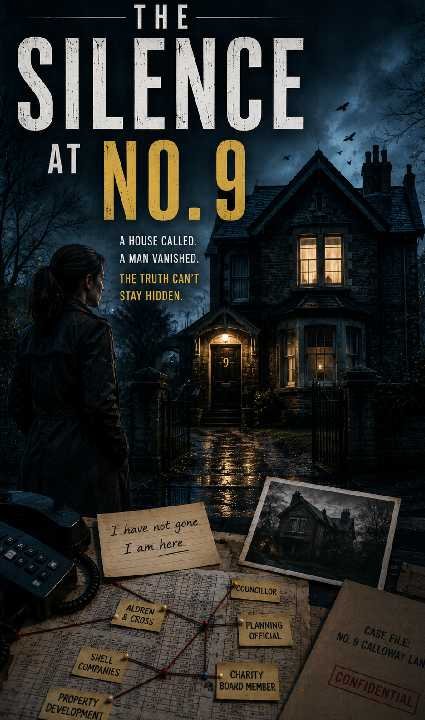
The Silence at No. 9
In The Silence at No. 9, a detective must uncover the truth behind a missing man before powerful enemies erase every clue.
Chapter 2: What Edmund Saw
The answer was in his study, which took Iris the better part of the morning to find because the study was not a room on any floor plan she could identify from the house’s exterior dimensions. It was a space carved from the back of a large wardrobe in the master bedroom not hidden dramatically, not concealed behind a mechanism, just a door that looked like the back panel of a wardrobe until you pressed it and it opened and there was a small, low-ceilinged room beyond, lined with cork board and paper and the concentrated evidence of a man who had been trying very hard to understand something for a very long time.
Edmund Grath, it turned out, was an accountant. Had been for thirty years, the last fourteen of which had been spent at a private wealth management firm called Aldren & Cross. On the cork board, connected by the kind of coloured thread that looked obsessive and turned out to be completely rational when you understood what it was connecting, was a map of transactions. Numbers. Dates. Company names that dissolved into other company names in the way that money moves when it is trying not to be seen.
Iris stood in the low room with a torch and followed the threads.
The money and there was a great deal of it, enough that the numbers had stopped feeling like numbers and started feeling like a different unit of measurement entirely moved from a series of shell companies through a property development firm and into the personal accounts of three individuals whose names Iris recognised. A city councillor. A planning official. A man who sat on the board of a housing charity and whose photograph appeared regularly in the newspaper beside the word philanthropist.
Edmund had found corruption. Patient, systemic, well-constructed corruption, the kind that took years to build and longer to see if you weren’t specifically looking. And Edmund, doing his job, following a number that hadn’t resolved the way it should, had seen it.
On the back of the largest sheet of paper pinned to the board, in the same precise handwriting as the index card: a date. Three days ago. And beneath it: They know I’ve seen it. I can’t stay but I can’t take this with me. Whoever finds this please make sure it doesn’t disappear the way they want it to.
Iris photographed every page. Every thread. Every number and name and date on the board. She transferred the files to her personal drive as well as the department server, and then she stood in the small hidden room and thought carefully about who she told first and in what order and why.
Because if Edmund Grath had been right and the board said he was then some of the people she would normally take this to were exactly the people the board named. And a woman who took evidence of corruption to the corrupt was not an investigator. She was a loose end being tidied.
She needed to be smarter than the situation. She was good at that. It was, more or less, the only thing she had ever been reliably good at.
She took one last photograph of the index card I have not gone. I am here and put it in her pocket. A man who had seen something he shouldn’t have and had hidden everything he knew in a room inside a room, and then called the police from his own phone at 6 a.m. and left the line open just long enough to be heard.
Not a disappearance. A signal.
Iris walked out of the house at No. 9 Calloway Lane, got into her car, and drove not to the station, not yet to the one person she trusted completely, a retired journalist who had spent forty years being told that certain stories were not worth pursuing and had pursued them anyway.
Edmund Grath had left a trail for someone willing to follow it.
Iris Vane was willing.
💬 Reviews
✨ Trending Stories
 The Cartographer of Small Things
 is a touching story about grief, memory, and finding meaning in life's quiet, overlooked moments.
The Cartographer of Small Things
The Cartographer of Small Things is a touching story about grief, memory, and finding meaning in life's quiet, overlooked moments.
 The Wrong Door
When Nora finds her neighbour unconscious, The Wrong Door becomes a fast-paced thriller filled with secrets, danger, and betrayal.
The Wrong Door
When Nora finds her neighbour unconscious, The Wrong Door becomes a fast-paced thriller filled with secrets, danger, and betrayal.
 The Map of No Return
 follows a brilliant cartographer and a fearless jungle guide as they uncover a lost city and ancient secrets.
The Map of No Return
The Map of No Return follows a brilliant cartographer and a fearless jungle guide as they uncover a lost city and ancient secrets.
 The Last Exhibit
Read The Last Exhibit, a gripping mystery where a detective and a master art forger uncover stolen masterpieces, hidden secrets, and a decades-old conspiracy.
The Last Exhibit
Read The Last Exhibit, a gripping mystery where a detective and a master art forger uncover stolen masterpieces, hidden secrets, and a decades-old conspiracy.
 The Ink and the Crown
Read The Ink and the Crown, a historical romance where a fearless journalist and a disgraced lord uncover a dangerous conspiracy that could change Victorian England forever.
The Ink and the Crown
Read The Ink and the Crown, a historical romance where a fearless journalist and a disgraced lord uncover a dangerous conspiracy that could change Victorian England forever.
 The Space Between Songs
Read The Space Between Songs, a heartfelt romance about a music publicist and a celebrated songwriter who discover love, healing, and second chances through music.
The Space Between Songs
Read The Space Between Songs, a heartfelt romance about a music publicist and a celebrated songwriter who discover love, healing, and second chances through music.