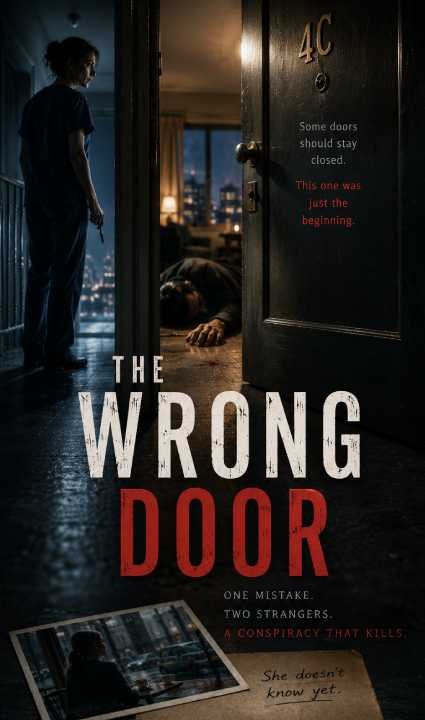
The Wrong Door
When Nora finds her neighbour unconscious, The Wrong Door becomes a fast-paced thriller filled with secrets, danger, and betrayal.
Chapter 2: What He Knew
His name was Marcus Fell and he woke up in a hospital bed at 3 a.m. and the first thing he said, before his eyes were fully open, was: “You need to leave the building.”
Nora had stayed. She wasn’t sure why professional habit, or the photograph still in her coat pocket, or simply the feeling that leaving felt more dangerous than knowing. She was sitting in the chair beside his bed when he spoke, and she leaned forward and said quietly, “Who are you?”
He looked at her. His eyes were clearer than she expected for someone who had been unconscious two hours ago. Focused. The eyes of someone who had been awake, in some important sense, for a very long time.
“I work worked for a private intelligence firm,” he said. “Contracted to monitor certain individuals flagged by a client I can’t name. You were on the list.” He paused. “You shouldn’t be. That’s what I was trying to work out. That’s why I have the photograph I was building a file on why you’d been flagged, trying to find the connection.”
“What connection?”
“To a man named Reeve. Dorian Reeve.” He watched her face carefully. “You don’t know that name.”
“I’ve never heard it.”
“That’s what I thought.” He closed his eyes briefly. “Which means whoever added you to the list did it for a reason that has nothing to do with Reeve. Which means someone inside the firm put you there.” He looked at the ceiling. “And the only reason to add an innocent person to a surveillance list is to have a reason to move against them later. A justification on paper. A file that says you were a person of interest, so that whatever happens to you looks like consequence instead of intent.”
The ward was quiet around them. A monitor beeped softly somewhere down the corridor. Nora sat with the information and felt it settle into her like cold water.
“Someone is planning to hurt me,” she said. Not a question.
“Someone is building the paperwork to make it look justified after the fact,” he said. “Which means they haven’t moved yet. Which means there is still time.” He turned his head to look at her directly. “But I don’t know how much. And whoever came to my flat tonight whoever put me on the floor they know I’ve been asking questions.”
“Why are you telling me this?” she asked. “You were surveilling me. You work for these people.”
“Worked,” he said again. “Past tense. As of tonight.” He reached for the glass of water on the bedside table with the careful movement of someone whose head was still making its objections known. “I’ve been doing this job for six years and I have never once found an innocent person on a list. You’re the first. That matters to me.” He drank. Set the glass down. “Also, they put me on the floor in my own hallway, so I have personal reasons as well.”
Despite everything the photograph, the cold fear sitting in her chest, the fluorescent ward light and the 3 a.m. wrongness of all of it Nora almost smiled.
“What do I do?” she said.
“First,” he said, “you don’t go back to the flat. Not tonight. Not until we know who inside the firm built your file.” He shifted against the pillow and winced. “Second, you think very carefully about whether there is anything in your life anything at all, however small that connects you to someone powerful enough to want this done. A patient you scanned. Something you saw at work. Anything.”
Nora thought. She was good at thinking under pressure. It was the thing her colleagues said about her, the thing she’d built her whole professional life on the ability to look at an image and see what was actually there rather than what you expected to find.
She thought about the scan she’d done three weeks ago. The man who had come in under a false name she’d known it was false because the demographic data hadn’t matched the referral paperwork, and she’d flagged it to administration and been told to leave it, not her department, not her problem.
She thought about what she’d seen on that scan. The thing she’d written in her notes and then been told, very quietly, by a consultant she’d never met before or since, to remove from the record.
Her mouth went dry.
“I think,” she said slowly, “I know what they’re afraid of.”
Marcus Fell looked at her with the expression of someone who had hoped she would say something like that and dreaded it in equal measure.
“Tell me,” he said.
💬 Reviews
✨ Trending Stories
 The Cartographer of Small Things
 is a touching story about grief, memory, and finding meaning in life's quiet, overlooked moments.
The Cartographer of Small Things
The Cartographer of Small Things is a touching story about grief, memory, and finding meaning in life's quiet, overlooked moments.
 The Silence at No. 9
In The Silence at No. 9, a detective must uncover the truth behind a missing man before powerful enemies erase every clue.
The Silence at No. 9
In The Silence at No. 9, a detective must uncover the truth behind a missing man before powerful enemies erase every clue.
 The Map of No Return
 follows a brilliant cartographer and a fearless jungle guide as they uncover a lost city and ancient secrets.
The Map of No Return
The Map of No Return follows a brilliant cartographer and a fearless jungle guide as they uncover a lost city and ancient secrets.
 The Last Exhibit
Read The Last Exhibit, a gripping mystery where a detective and a master art forger uncover stolen masterpieces, hidden secrets, and a decades-old conspiracy.
The Last Exhibit
Read The Last Exhibit, a gripping mystery where a detective and a master art forger uncover stolen masterpieces, hidden secrets, and a decades-old conspiracy.
 The Ink and the Crown
Read The Ink and the Crown, a historical romance where a fearless journalist and a disgraced lord uncover a dangerous conspiracy that could change Victorian England forever.
The Ink and the Crown
Read The Ink and the Crown, a historical romance where a fearless journalist and a disgraced lord uncover a dangerous conspiracy that could change Victorian England forever.
 The Space Between Songs
Read The Space Between Songs, a heartfelt romance about a music publicist and a celebrated songwriter who discover love, healing, and second chances through music.
The Space Between Songs
Read The Space Between Songs, a heartfelt romance about a music publicist and a celebrated songwriter who discover love, healing, and second chances through music.